Expert Advice On Improving Your Home
Expert Advice On Improving Your Home
Please enter a valid 5-digit zip code!
Written By David Cusick
Last Updated April 2024
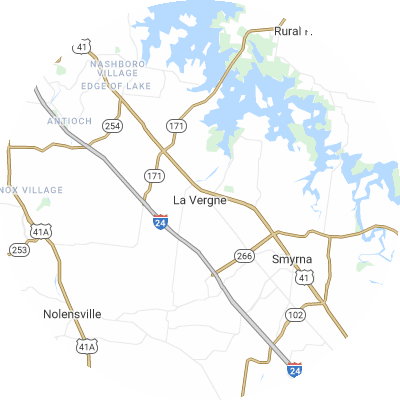
Rooftop solar is one of the most easily accessible forms of renewable energy for La Vergne homeowners. Switching to solar energy can allow you to save money and lower your carbon footprint, but you want to make sure you find a reputable installer. Luckily, we’ve analyzed local solar providers and compiled a guide to the best solar companies in La Vergne. These proven and dependable providers are reliable options known for their quality services.

Informative resources
Reliable customer support
Free quotes
Prompt service delivery
Services Offered
Clear pricing policy
Free quotes
Reliable customer support
Services Offered
Reliable customer support
Clear pricing policy
Informative resources
Free quotes
Prompt service delivery
Services Offered
Clear pricing policy
Informative resources
Free quotes
Reliable customer support
Services Offered
Reliable customer support
Informative resources
Clear pricing policy
Services Offered
Informative resources
Clear pricing policy
Reliable customer support
Free quotes
Services Offered
Reliable customer support
Prompt service delivery
Informative resources
Services Offered
Clear pricing policy
Informative resources
Services Offered
Clear pricing policy
Informative resources
Free quotes
Reliable customer support
Services Offered
Today's Homeowner looks at dozens of datapoints on solar companies to come up with our data-driven rankings. It's not possible for a company to pay for preferential treatment in our rankings. We look at the following key factors in determining who should top our list:
Going solar can be a great way to save money on electricity costs and help the environment by reducing your carbon footprint using renewable energy. Here are some key factors to consider when determining whether a solar installer is reliable.
Verify that your solar installer is properly licensed. This ensures that the work is done correctly using the most up-to-date installation methods. Tennessee requires any solar energy project valued at $25,000 or higher to be overseen by a licensed "prime contractor." The prime contractor is responsible for hiring licensed subcontractors as the job requires. Even if a project doesn't cross the $25,000 value threshold, you will still need a master electrician or electrical journeyman to pull permits.
Look at review platforms such as the Better Business Bureau (BBB), Google Reviews, and TrustPilot to find out what previous customers say about local solar companies. Reviews can give you an idea of a company’s reliability and customer service. Be wary of companies lacking reviews or with predominantly negative feedback.
To find a solar company that fits your budget, get free, detailed quotes from 3–5 providers. The quotes should list all costs as well as all solar equipment included. Looking at several quotes helps you identify the option that best fits your budget.
High-quality solar installations should come with robust workmanship and performance guarantees. The workmanship guarantee covers any installation issues like poor alignment, cracks in the panels, or poor wiring. The output warranty guarantees an energy generation baseline. Strong guarantees reflect a solar provider's confidence in its installations.
Going solar can help reduce your energy expenses. Be sure to consider these aspects when determining the cost and value of solar panels.
La Vergne homeowners typically spend about $20,010 on home solar systems after federal tax refunds. Solar arrays in La Vergne cost roughly $3,580 per kilowatt, with the average residential solar system being 8.0 kilowatts. An estimate from a local solar provider will include costs for permit fees, labor, and preliminary work, and will account for your system's panel type, size, and capacity. Some homeowners prefer to lease their solar panels to reduce upfront costs.
Incentive Type: Property Tax Incentive
Incentive Amount:
Depends upon sector
Generally speaking, a solar photovoltaic (PV) array can be used to power any household appliance or system that uses electricity. In the smallest case, you can use a solar water heater.
With home solar PV, you can save money on your energy bill, lower your home's carbon footprint, and be better prepared if there's an outage to the local grid.
Absolutely. The grid in La Vergne already uses a large share of renewable energy sources, and you may be able to sell your excess generated energy to your utility for additional cost savings.
Generally speaking, your energy bills will significantly decrease after you install solar panels. This is because you're using the energy you generate for free rather than buying it from your power company. In La Vergne, the average amount someone can save is $878 per year. With net metering programs offered by many utilities, you could ultimately make a profit from your system when your payback period is done.
Net metering is a power purchasing policy that allows solar energy system owners to receive compensation for the amount of energy they put back into the grid. It's available in most states and is a great way to reduce energy costs.
While solar energy is an ideal option for many, it might not be ideal for homeowners in wet, dark areas. In these cases, you could consider other forms of renewable energy, such as wind or geothermal power, as a primary source. It is also important to speak to a qualified installer to determine if their solar system is compatible with the climate and environment of your area. Even if you choose a different form of renewable energy altogether, you'll still lower your emissions and could still qualify for distributed generation or other money-saving programs.