Expert Advice On Improving Your Home
Expert Advice On Improving Your Home
Please enter a valid 5-digit zip code!
Written By David Cusick
Last Updated April 2024
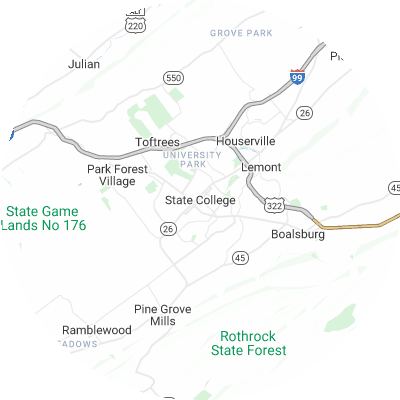
Rooftop solar is one of the most easily accessible forms of renewable energy for State College homes. Transitioning to solar energy can lower your monthly energy expenses and decrease your carbon output. Before you get started, you want to make sure you find a reputable installer. That’s why we’ve analyzed the options and compiled a guide to the most reliable solar installation companies in State College. These top installers offer high-quality and reliable services.


Clear pricing policy
Free quotes
Informative resources
Reliable customer support
Services Offered
Reliable customer support
Clear pricing policy
Services Offered
Free quotes
Reliable customer support
Clear pricing policy
Services Offered
Free quotes
Services Offered
Prompt service delivery
Free quotes
Clear pricing policy
Services Offered
Clear pricing policy
Free quotes
Informative resources
Reliable customer support
Services Offered
Today's Homeowner looks at dozens of datapoints on solar companies to come up with our data-driven rankings. It's not possible for a company to pay for preferential treatment in our rankings. We look at the following key factors in determining who should top our list:
Putting solar panels on your roof could reduce your electricity payments while benefiting the planet by reducing your carbon footprint through renewable energy use. Key considerations when looking at local solar installers are as follows.
Make sure you hire a licensed solar installer. This ensures that the work is done correctly using the most up-to-date installation methods. There are no state-level contracting licenses issued in the Commonwealth of Pennsylvania, so each city or county can set its own requirements and regulations.
Check the Better Business Bureau (BBB), Google Reviews, TrustPilot, and other review sites to see what past customers have to say about local solar providers. Detailed reviews on these platforms can help you assess a provider's reliability and customer service. Avoid providers with few or mainly poor reviews.
Get free, detailed quotes from at least three solar companies. The quotes should outline all costs and identify the solar parts included. Comparing several quotes can help you find the most cost-effective option.
High-quality solar installations should include robust workmanship and performance guarantees. The workmanship guarantee covers any installation issues like cracks in the panels, poor alignment, or poor wiring. The output guarantee ensures an energy generation baseline. Strong warranties reflect a solar provider's confidence in its installations.
Going solar can help lower your electric bills over time. When evaluating the total price and value of solar panels, make sure to consider these factors.
State College homeowners typically spend about $17,416 on home solar systems after federal tax refunds. Solar arrays in State College cost roughly $3,550 per kilowatt, with the average residential solar system being 7.0 kilowatts. An estimate from a local solar provider will include costs for labor, preliminary work, and permit fees, and will account for your system's size, capacity, and panel type. Some homeowners prefer to lease their solar panels in order to reduce upfront costs.
Incentive Amount:
Manufacturer loans: $40,000 per job created within 3 years
Manufacturer grants: $5,000 per job created within 3 years
Loans for geothermal systems: $3 per square foot of space served up to $5 million; also limited to 50% of eligible costs for residential systems.
Loans for wind energy production projects: $5 million
Grants for wind energy production projects: $1 million
Grants for feasibility studies: 50% of cost up to $175,000
Loan guarantee grants: Up to 75% of deficient funds up to $5 million
Incentive Amount:
Varies based on market conditions; during 2015 the market price for PA-sourced SRECs has ranged from approximately $32 - $55/MWh ($0.032 - $0.055/kWh) although individual trades have taken place at substantially lower and higher prices.
Incentive Amount:
Appliances
Refrigerator: $75
Clothes Washer: $25- $50
Clothes Dryer: $50
Freezers: $25
Dehumidifiers: $25
Fridge/Freezer Recycling: $50
HVAC
HVAC tune up: $50
Furnace Fan Motor: $150
Ductless Minisplit AC : $200
Central AC: $100 - $200
Air Source Heat pump: $250 - $500
Geothermal Heat Pump: $600
Packaged Terminal AC: $75
Packaged Terminal Heat Pump: $150
Programmable Thermostat: $25
Others
Solar Water Heat: $500
Heat Pump Water Heater: $500
Home Energy Audit: $250
Lighting: Available as in-store discount in participating stores
A solar photovoltaic (PV) system can generate power to run any electric system or appliance in your home. A more specific example is installing a solar heating system for your water.
With home solar panels, you can recoup the cost of the system over time, lower your property's emissions, and gain additional energy independence.
It depends on your location and the kind of panels you plan to use. State College can experience long, hard winters, so we recommend installing your system in the spring months to maximize your generation for the year.
Yes, you can use home solar energy alongside conventional power sources. In most parts of the country, solar panels are designed to supplement your existing energy sources, which means you can reap the savings and environmental benefits that come from using solar energy without having to completely switch over.
Your payback period is the time to earn a net profit from your solar panels. It will vary based on their rated capacity, the average sunlight in your area, and the rate your utility charges per kilowatt of power. State College gets a moderate amount of sunlight each day, so you could expect a maximum payback period of 17.9 years per 5 kW of power depending on other factors.
Although solar energy is a great option for many, it might not be ideal for homeowners in wet, dark areas. In these cases, a contractor might recommend other forms of renewable energy, such as wind or geothermal power, as a primary source. It is also important to speak to a qualified installer to determine if their solar system is compatible with the climate and environment of your area. Even if you choose a different form of renewable energy altogether, you'll still help the environment and could still qualify for distributed generation or other money-saving programs.
Ultimately, the answer will depend on your specific situation. You can take advantage of a federal tax credit of up to 30% of the system's cost, as well as state or local incentives depending on where you are. As for insurance, you'll need to notify your insurer about your new solar panels. Your premium may increase due to added property values, but you'll have peace of mind if a covered event happens to the system.